Freelancer & Contractor Management Tools: The Complete 2026 Guide for Agencies

 Agency Management9 min read
Using proper freelancer and contractor management tools is the difference between running a scalable, compliant freelance bench and spending half your week chasing overdue invoices, missing tax forms, and fragmented project updates. Built specifically for agencies managing external talent at volume, these platforms centralise everything from onboarding and compliance classification to time tracking, deliverables, and multi-currency payouts.
The payoff is immediate: fewer administrative hours, faster and more predictable payments for your talent, and far lower compliance risk from misclassifying workers across tax jurisdictions. If your agency relies on a network of external specialists, this software isn’t a luxury anymore; it’s operational infrastructure.
What Are Freelancer and Contractor Management Tools, and Do Agencies Actually Need Them?
These platforms provide a single, unified system of record to handle the entire lifecycle of your external workforce. Rather than piecing together email chains for briefs, isolated spreadsheets for day rates, and manual bank transfers for payment, agencies use these tools to automate the heavy lifting of working with freelancers.
The switch from manual processes to dedicated software usually happens at a specific operational breaking point. You probably need this if:
- You manage 10 or more active freelancers. The friction of chasing invoices, drafting agreements, and signing individual NDAs becomes unmanageable for account managers past this threshold.
- Your payment runs are manual. If finance is processing individual bank transfers and absorbing FX fees for international talent, the current process is costing you real margin.
- You face compliance risk across jurisdictions. Operating without a standardised way to collect tax documentation and verify contractor classification puts the agency at genuine legal risk, IR35 penalties in the UK, or 1099 misclassification fines in the US.
- Talent retention is slipping. If freelancers are declining work because onboarding is disjointed or payments are consistently late, your internal systems are actively harming your creative output.
- You lack spend visibility. Contractor costs scattered across disjointed invoices and expense claims make it impossible to accurately forecast project margins.
How Zynito approaches agency operations->
What a Freelancer Management System Actually Covers
A freelancer management system (FMS) is built specifically to handle the complexities of a contingent workforce. Where traditional HR software assumes full-time employees on standard payroll, an FMS is designed around flexible engagements, variable day rates, cross-border compliance, and project-based deliverables.
A complete freelancer management system typically covers:
- Sourcing and talent pooling: a searchable internal database of vetted freelancers, categorised by skill, day rate, past performance, timezone, and availability
- Onboarding and classification: capturing right-to-work checks, bank details, and compliance questionnaires so someone is legally classified as a contractor rather than a hidden employee
- Contracting and e-signatures: generating and executing NDAs, MSAs, and project-specific statements of work natively, without leaving the platform
- Task and time tracking: logging billable hours or milestones against the agreed scope, so client budgets are respected and over-servicing gets flagged early
- Invoicing and approvals: generating invoices from approved timesheets or milestones, routed automatically to the right sign-off
- Payment and remittance: bulk payment runs across currencies and jurisdictions, settled via a single monthly invoice to the software provider
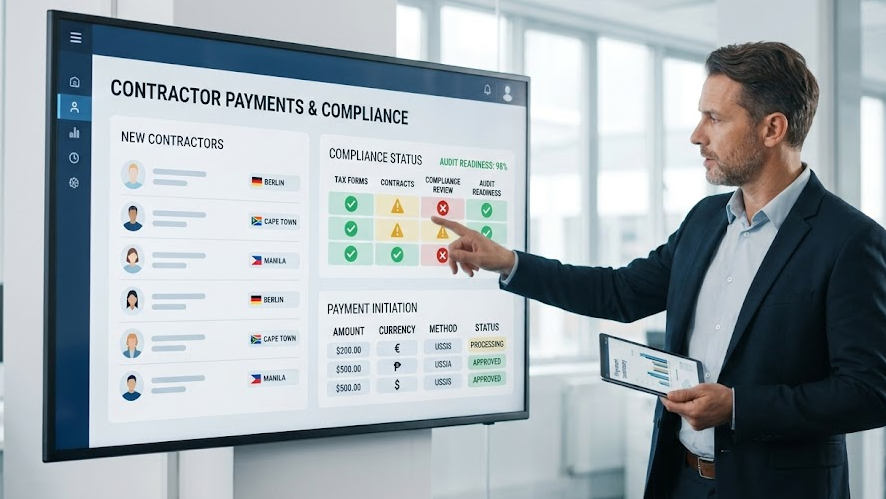
- Compliance and tax documentation: generating and storing end-of-year tax forms, with a clear audit trail for financial authorities

The Core Features to Look For
Finding the best software for managing freelancers means evaluating tools against your agency’s daily operational reality, not the marketing page. Robust financial plumbing and legal safeguards matter far more than a polished interface.
| Feature | Why it Matters | What to Check When Evaluating Vendors |
| Onboarding & Classification | Protects the agency from penalties tied to worker misclassification | Does the platform actively assess contractor risk in your jurisdictions, or just act as a digital filing cabinet? |
| Contract & E-Signature Management | Removes the back-and-forth of sending PDFs, gets talent started on billable work faster | Are NDAs and MSAs generated natively, and are e-signatures legally binding globally? |
| Time Tracking & Deliverable Approval | Ties payments directly to approved work, preventing scope-creep disputes | Can freelancers submit both milestone-based and hourly approvals? |
| Multi-Currency & Multi-Method Payments | Saves on unnecessary FX fees, ensures talent receives the full agreed amount | Does the vendor support local bank transfers, and how transparent is their FX markup? |
| Unified Workspace Integration | Keeps subcontractors from working in silos | Can you manage internal teams, partner companies, and freelancers from a single account? |
| Reporting & Spend Visibility | Lets leadership track margins and forecast contingent workforce spend | Can you filter spend by client, project, or department for accurate profitability? |
Agency Contractor Payment Software: What Actually Matters
When evaluating agency contractor payment software, the conversation shifts from basic functionality to operational scale. Manual bank transfers work fine when paying three local copywriters. They become a logistical headache when paying thirty specialists spread across five continents.
Dedicated payment software consolidates your entire freelance payroll into one workflow. Instead of authorising fifty separate transfers through your banking portal, finance pays a single bulk invoice, and the platform routes funds to individual contractors in their local currencies.
Agencies switching from manual processing to automated payment systems routinely report saving upwards of 20 hours a month in finance admin. Handling foreign exchange at scale also requires dedicated infrastructure; without it, either the agency absorbs unpredictable transfer fees, or the freelancer loses a percentage of their day rate to hidden banking charges.
Compare Zynito’s plans and features->
Comparing the Best Freelancer and Contractor Management Tools
Comparing these platforms means looking past the marketing pages to understand how each one actually monetises and where its real strengths lie.
| Tool | Category | Best For | Standout Feature | Pricing Reality | Honest Trade-off |
| Zynito | Agency OS & Project Management | Agencies managing internal teams, clients, and external contractors in one platform | Complete centralisation: tasks, chat, time tracking, and partner companies from one account | Free plan (up to 3 members); paid from $4.99/seat/month, bundled from $9.99/seat/month | Requires committing to migrating your core operations to get the full benefit |
| Worksuite | Full-Lifecycle FMS | Mid-to-large agencies needing heavy compliance and custom onboarding | Onboarding checklists that adapt by country and role | From roughly £35/$45/month per active contractor | Robust for enterprise risk, but can feel administratively heavy for smaller teams |
| Remote | EOR & Contractor Payments | Agencies scaling a global workforce across strict tax jurisdictions | Global compliance and IP protection across 150+ countries | Roughly £23/$29/month per active contractor | Built primarily as an Employer of Record; contractor features are secondary |
| YunoJuno | Sourcing & FMS Hybrid | UK and European agencies reliant on elite creative and tech talent | Access to a vetted marketplace of 150,000+ freelancers | Custom pricing, typically a 4-12% fee on payments | Best if you need to source new talent; less cost-effective with an existing black book |
| Bubty | Internal Talent Pool FMS | Agencies wanting a white-labelled private freelance network | Build a proprietary, branded talent pool rather than an external marketplace | Custom enterprise pricing | No built-in marketplace; you bring your own contractors to populate it |
A note on pricing: headline prices are usually calculated for a small handful of workers. Model the real cost at your actual volume. If your bench is 50 freelancers but you only use 10 in a given month, make sure you’re evaluating tools that charge for active users only, not dormant seats.
How to Manage Remote Contractors for Agencies
Software alone won’t fix a broken operational culture. Knowing how to manage remote contractors for agencies requires clear communication protocols and a commitment to integrating external talent smoothly, without blurring legal lines.
- Enforce structured onboarding. Don’t send a brief or grant project access until NDAs, bank details, and right-to-work documents are collected and signed.
- Write flawless, comprehensive briefs. Remote contractors can’t absorb context from overheard conversations. Be exhaustive on deliverables, deadlines, format, and who to contact for approvals.
- Establish a single system of record. Move contractor communication out of siloed email threads. Whether that’s threaded chat tied directly to tasks, or a shared client portal, mandate one centralised, searchable home for files and feedback.
- Commit to a predictable payment cadence. Set strict, non-negotiable terms (net-14 or net-30) and stick to them. Automated payment software prevents delays caused by manual processing errors.
- Practise light-touch inclusion. Maintain legal boundaries to avoid misclassification, but still invite contractors to relevant kick-offs and share the results of the work they contributed to.
Build vs Buy: Do You Need Dedicated Software, or Will a Spreadsheet Still Do?
If your agency works with three local freelancers, paying them by standard bank transfer and tracking hours in a shared spreadsheet is perfectly fine. At that scale, dedicated freelancer and contractor management tools are more overhead than they’re worth.
Spreadsheets break down the moment complexity arrives: hiring across borders, juggling multiple currencies, tracking different day rates by discipline, or managing more than ten active contractors. Once account managers start complaining about onboarding time, or finance flags the volume of manual invoices, the spreadsheet has outlived its usefulness, and it’s time to properly evaluate freelancer and contractor management tools.
See how Zynito’s pricing compares->
Common Mistakes Agencies Make Managing Contractors
- Worker misclassification. Dictating specific working hours, forbidding other clients, or providing company equipment can trigger serious tax penalties.
- Ad hoc bank transfers. Paying international talent manually forces someone to absorb exchange rate losses and SWIFT fees, eroding trust.
- No centralised audit trail. Storing compliance documents across personal drives or scattered in inboxes practically guarantees a crisis during an audit.
- Bypassing onboarding. Letting an account manager brief a freelancer before the MSA and NDA are signed exposes the agency to IP and confidentiality risk.
- Ghosting after the project. Failing to close the loop means constantly starting from scratch instead of building a reliable long-term bench.
FAQs
- What are freelancer and contractor management tools?
They’re digital platforms that centralise and automate the entire lifecycle of an agency’s external workforce, onboarding, compliance checks, contract e-signatures, time tracking, invoicing, and multi-currency payments, all within a single system of record.
- What’s the difference between a freelancer management system and payroll software?
Payroll software is built for full-time employees, handling fixed salaries, tax deductions, and benefits. A freelancer management system is built for contingent workers, managing variable day rates, milestone approvals, and bulk invoicing without misclassifying external talent as internal staff.
- Do small agencies need dedicated software, or is a spreadsheet enough?
A spreadsheet is usually sufficient for fewer than ten local freelancers. Once you scale internationally or start processing dozens of variable invoices monthly, the compliance risk and wasted admin hours justify dedicated software.
- How do I pay international freelancers without high fees?
Use dedicated contractor payment platforms. These let the agency pay one bulk invoice in its local currency, while the software routes funds directly to the freelancer’s account through local banking networks with minimal FX markup.
- How do you avoid misclassifying a freelancer as an employee?
Avoid dictating exactly how, when, and where work is completed. Legitimate contractors use their own equipment, retain the right to work with other clients, and get paid against submitted invoices for agreed deliverables, not a fixed salary.
- How do I manage remote contractors so they feel part of the team?
Provide comprehensive briefs and centralise communication in a shared workspace rather than isolated emails. Share the outcomes of projects they contributed to, offer constructive feedback, and guarantee predictable, on-time payments.
Ready to streamline your freelance operations and manage partner companies without the chaos? The right freelancer and contractor management tools should feel invisible once they’re working properly. Start a free Zynito trial, no credit card required, and bring your internal team, clients, and contractors into one unified workspace.
Run your agency from one platform
Projects, client communication, and team chat together in Zynito.