Time Tracking Software for Agencies: Features You Can’t Skip

 Agency Management8 min read
Implementing time tracking software for agencies is the only reliable way to protect your profit margins from scope creep and undocumented over-servicing. Built for project-based businesses, these platforms move agencies away from gut-feeling profitability and retrospective spreadsheet entry. The core payoff is absolute visibility: you capture exactly where your team’s effort is going, instantly differentiate billable client work from internal administrative drain, and generate accurate invoices directly from logged hours. If you sell time and expertise, an integrated tracking system is your financial safeguard.
The Operational Tipping Point: When Spreadsheets Fail
Time tracking software provides the definitive system of record for your agency’s capacity and profitability. Instead of relying on creatives trying to remember what they did last Tuesday, agencies use these tools to capture time in the moment. The transition from manual tracking usually happens when an agency can no longer confidently answer whether a specific retainer is actually profitable.
You probably need this if:
- You consistently over-service accounts: If client work frequently bleeds past the agreed scope, but you cannot quantify the exact financial loss to negotiate a larger retainer.
- Your team relies on end-of-week memory: Forcing staff to manually reconstruct their week on a Friday afternoon guarantees lost billable hours and wildly inaccurate data.
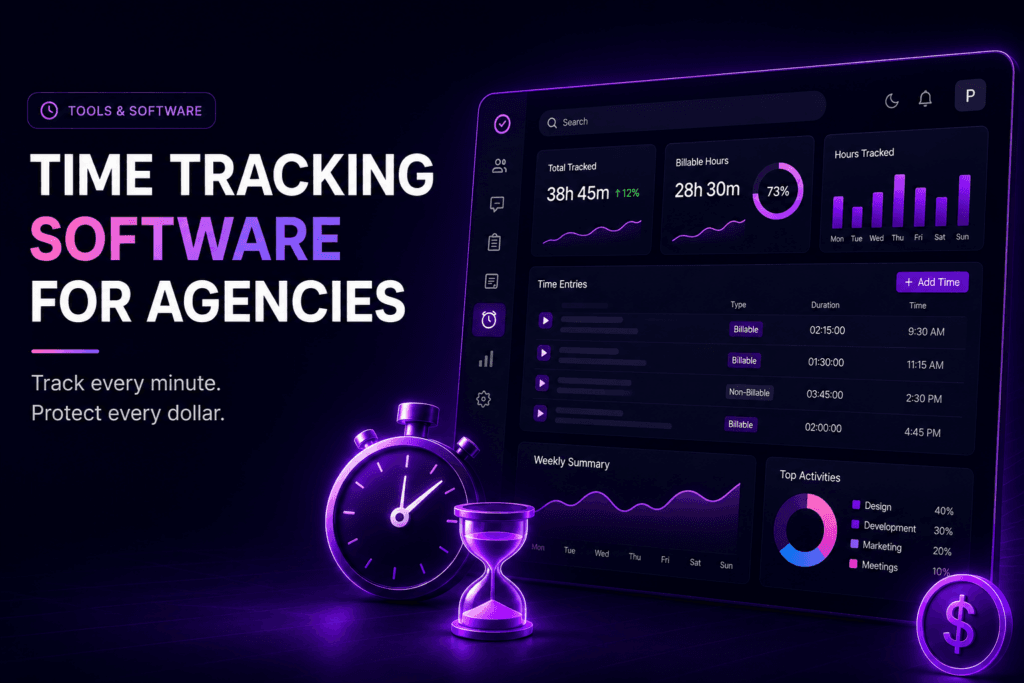
- You lack visual reporting: If you cannot immediately view dashboards displaying project progress and hour logs through high-resolution visual graphics, you are operating in the dark.
- Invoicing is an administrative nightmare: If finance has to manually cross-reference account manager notes with creative timesheets to calculate a client’s monthly bill.
- You do not know your true utilisation rate: You cannot accurately state what percentage of your team’s time is spent on revenue-generating work versus internal meetings.
Stop losing billable hours to fragmented apps and Friday-afternoon guesswork. Centralise your tasks, track time directly within your workflows, and measure true project margins with Zynito’s Agency OS. Start a free Zynito trial, no credit card required.

The Core Features to Look For
Finding the best time-tracking best time tracking software for marketing agencies requires looking beyond basic stopwatches. The right time tracking software for agencies should integrate seamlessly into your team’s daily workflow without feeling like a surveillance mechanism.
| Feature | Why it Matters | What to Check When Evaluating Vendors |
| Frictionless Entry Methods | If a tool is difficult to use, creatives will simply avoid it. | Does it offer one-click timers, calendar integrations, and desktop apps, rather than forcing manual text entry? |
| Billable vs. Non-Billable Toggles | Essential for calculating true utilisation rates and identifying internal administrative bloat. | Can users easily categorise time at the task level, ensuring non-billable hours never appear on client invoices? |
| Visual Dashboard Reporting | Raw data is useless without immediate visual context for leadership and account managers. | Does the platform provide high-resolution visual graphics mapping hour logs against the total allocated project budget? |
| Invoicing Integrations | Transforms logged hours directly into revenue without manual data entry. | Does this billable hours tracking software sync directly with Xero, QuickBooks, or generate its own native invoices? |
| Capacity & Resource Planning | Prevents you from burning out your best staff while others sit idle. | Can you forecast future availability based on historical tracked time and upcoming project phases? |
Agency Time Tracking Tools: Comparison Table
Evaluating employee time tracking software for agencies means balancing powerful reporting for management against a frictionless user experience for the team doing the work.
| Tool | Category | Best for | Standout Feature | Pricing Reality | Honest Trade-off |
| Zynito | Agency OS & Project Management | Agencies wanting to unify task management, team chat, and time tracking in one platform. | Seamless workflow: time is tracked directly on the task card without leaving the project workspace, feeding real-time margin reports. | Free plan (up to 3 members); paid tiers from $4.99/seat/month, bundled Projects + Chat from $9.99/seat/month ($7.99 billed annually). | Requires fully adopting the platform for task management to get the true benefit of integrated tracking. |
| Harvest | Standalone Billable Tracker | Agencies that just need strict financial tracking and invoicing. | Incredibly robust native invoicing and budget-burn alerts sent directly to account managers. | Roughly £10/$12 per user, per month. | It is purely a financial tool; it must be heavily integrated with a separate project management app to track actual deliverables. |
| Toggl Track | Frictionless Time App | Creative teams that rebel against overly corporate or clunky software interfaces. | The quintessential time tracking app for creative agencies: offers an intuitive, visually pleasing timeline and calendar integrations. | Roughly £14/$18 per user, per month for the Premium agency tier. | Lacks heavy-duty, native project management capabilities; can feel too lightweight for complex capacity forecasting. |
| Everhour | Integrated App Tracker | Agencies heavily reliant on existing tools like Asana, Trello, or Jira. | Embeds its timer directly into the UI of other popular project management tools via browser extensions. | Roughly £8/$10 per user, per month, with a 5-seat minimum on the Team plan. | Requires a 5-seat minimum even for smaller teams, and if their browser extension breaks or sync fails, your entire team’s time tracking halts immediately. |
| Clockify | Budget-Friendly Tracker | Large, growing teams needing a highly scalable and cost-effective tracking solution. | Offers a genuinely functional free tier for basic tracking (check current user limits before rolling out to larger teams). | Premium features start at roughly £3/$3.99 per user, per month (Basic tier). | The interface is highly utilitarian and less intuitive than Toggl, which can frustrate design-focused creatives. |
Why force your team to jump between Asana for tasks, Slack for chat, and Harvest for time? Keep your creatives focused and your margins accurate by tracking hours directly where the work happens. [Explore Zynito Projects]
Getting Billable and Non-Billable Time Right (Process, Not Just Tools)
Knowing how to track billable vs non-billable hours is the foundation of agency profitability. Software enables the tracking, but strict internal definitions ensure the data is actually useful.
- Define the Categories Ruthlessly: Create a permanent, agency-wide definition. Billable time is anything directly advancing a client’s specific deliverable (design, drafting, client calls). Non-billable time is everything else (internal team meetings, pitching, training, administrative emails).
- Bake Tracking into the Task: Do not allow generic time entries like “Client Work.” Staff must log time against specific, predefined tasks. This prevents hours from being hidden in broad categories.
- Track the Unbillable Accurately: Agencies often make the mistake of only tracking billable time. You must track internal meetings and admin to identify exactly where your non-billable bloat is occurring.
- Set Realistic Utilisation Targets: Do not demand 100% billable time from creatives. A healthy utilisation rate for an agency designer or copywriter is typically 75–80%, allowing 20% for internal admin, learning, and breaks.
- Review the Budget Burn Weekly: Account managers must check the ratio of logged hours against the total scoped hours every Friday. Catching a project that is 80% through its budget but only 50% complete allows you to intervene before the margin is entirely wiped out.

Common Mistakes Agencies Make with Time Tracking
- Weaponising the Data: Using time tracking to punish employees for being “too slow” rather than using it to identify when an agency has systematically under-priced a recurring deliverable.
- The Friday Afternoon Dump: Allowing staff to fill in their entire week of timesheets on Friday at 4:30 PM. The data will be entirely fictional. Tracking must be daily and contextual.
- Too Many Task Codes: Creating a dropdown menu with 400 different hyper-specific activity codes. Creatives will suffer decision fatigue and simply select the top generic option every time.
- Hiding Over-Servicing: Staff sometimes under-report their hours because they fear getting in trouble for blowing the budget. This is catastrophic; it trains the agency to consistently under-price future work based on false, artificially low historical data.
FAQs
- What is time tracking software for agencies?
Time tracking software is a digital tool that allows agency staff to log the exact minutes and hours spent on specific client tasks. It centralises this data to calculate project profitability, generate accurate invoices, and monitor overall team capacity.
- What is the best time tracking software for marketing agencies?
The best tool depends on your stack. Toggl Track is excellent for frictionless, creative adoption, while Harvest is ideal for strict financial invoicing. However, unified Agency OS platforms like Zynito are increasingly preferred because they combine time tracking, team chat, and task management into one workspace.
- How do you calculate billable utilisation?
Divide an employee’s total billable hours by their total available working hours, then multiply by 100. If a copywriter logs 30 billable hours in a 40-hour week, their utilisation rate is 75%.
- Should agencies track non-billable hours?
Absolutely. Tracking non-billable hours is the only way to identify operational bloat. If you discover your senior designers are spending 15 hours a week in internal status meetings, you can immediately restructure workflows to reclaim that revenue-generating time.
- How do I get my team to actually use time tracking apps?
Remove the friction and the fear. Integrate the timer directly into the tools they already use, and clearly communicate that the data is used to price projects accurately and prevent burnout, not to micromanage their bathroom breaks.
- What is the difference between time tracking and project management?
Project management software tracks the status of deliverables. Time tracking software for agencies tracks the effort and cost required to move those deliverables to completion. The most efficient agencies use unified platforms that natively handle both simultaneously.
Ready to stop guessing your margins and start tracking profitability directly within your daily workflows? [Book a Custom Zynito Demo] today to see how a unified Agency OS transforms your operational visibility.
Run your agency from one platform
Projects, client communication, and team chat together in Zynito.